
Raj Kumar, a 45-year-old civil engineer in Kanpur, had one goal in life – provide good education for his daughter. Realising cost of higher education, he was saving well, however, mainly in fixed deposits. On advice of a friend, he made his first equity investment in Yes Bank at ₹175 each. That was April, 2016, and the share was part of Nifty and had significant credibility.
After a couple of rallies, in less than two years, his first equity purchase rose to ₹400. Raj was very happy and bought more shares of Yes Bank. By this time there were other stocks in his portfolio, but yes bank remained his first love with more than 50% of holdings. When the Yes bank share price began to fall in late 2018, Raj didn’t flinch. Instead, he bought more shares. He believed using the concept of Rupee Cost Averaging (RCA), he can reduce average cost of Yes Bank purchases.
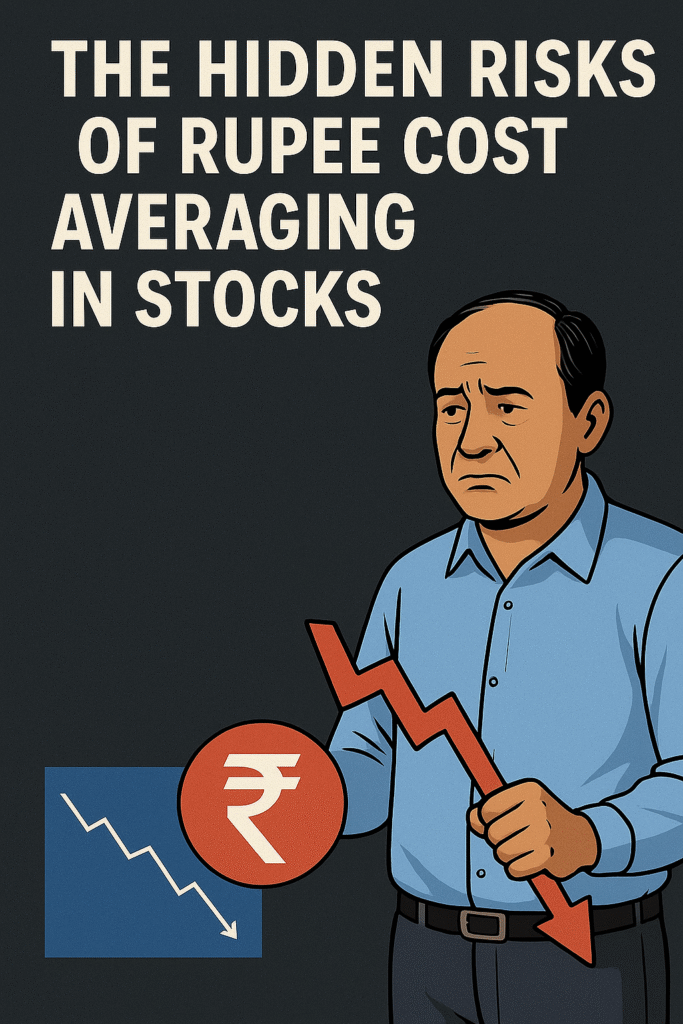
But Raj missed what the markets were trying to tell him: The fundamentals of the Bank were getting weaker with mounting bad loans. Promoter credibility was also eroding. By the time the RBI stepped in with a rescue plan in 2020, the stock had crashed to under ₹15, and Raj’s investments were down by nearly 80%.
Raj used RCA religiously — and still lost most of his savings.
The Bigger Picture
Raj’s case is not unique. There are about 2,400 listed companies in India that are currently trading at less than half their all-time highs. Shockingly, these includes about 1,000 stocks that are trading at less than one-fourth of their all-time highs. Still worser is the case of companies that are decimated with share price below 90% of their peaks. Often, some investors in these companies may have averaged down their purchases to sit on massive, often permanent losses.
RCA is not a bad strategy, but it assumes the underlying business will survive and recover. When that assumption fails, RCA becomes a tool for wealth destruction.
No company, big or small, is immune to downfalls or failures. There are only seven companies that have remained part of Sensex throughout its existence. Many others considered “blue chips” at some point of time, have either been delisted, merged, destroyed or at least lost value to be out of Sensex.
Why RCA Can Be Dangerous?
1. Averaging into a value trap: Investor may think of averaging costs. RCA magnifies the damage with falling stock prices.
2. The business may never recover: Not all downtrends are temporary. Structural problems like rising debt, internal frauds and mismanagement may lead companies to a position of no recovery.
3. Losses can be permanent: If a company enters insolvency, gets restructred, or faces extreme dilution, the monies invested may wipe out. RCA only increases exposure.
4. Size or prestige ≠ safety: Big companies fail too. Being a large cap or a prominent company recognised as part of the Sensex, Nifty, is no guarantee of long-term survival. Satyam, Yes Bank, and BILT are proof.
Implications for rupee cost averaging
RCA is not inherently flawed. At the same time, it is not immune to bad judgment. Here are key lessons:
1. Do not average down the costs blindly: Falling prices are not always opportunities. A significant price fall may signal deeper problems in the business functioning. Always reassess the fundamentals of stocks that are falling.
2. Use RCA only on fundamentally sound businesses: Good businesses bounce back. Broken ones do not. RCA only works if the company is worth owning.
3. Diversify portfolio: An investment portfolio that is not diversified and thus is lopsided towards few shares is prone to high risk. Spread investments across industries and market caps to reduce risk.
4. Watch for red flags: There are many signs of a company getting troubled. Investors should look for indicators like auditor resignations, exit by key managerial personnels or promoters, regulatory probes, mounting debts and employee problems.
5. Be willing to exit: There no disgrace in reducing losses by selling off investments with deteriorating fundamentals. Staying invested “hoping to recover” leads to deeper pain as companies may never recover.
Endnote
Rupee cost averaging is a powerful tool for building wealth, however, it should be used with discipline and due diligence. Raj Kumar thought he was playing it smart by averaging into Yes Bank. But like many such investors, he forgot an important rule:
Do not average into bad companies. Exit them.
Also Read