
Many retail investors lose money in the of stock markets as they buy too late in changing market cycle. To protect their capital, they need to avoid position of being last buyer purchasing at high valuations. This article is a cautionary write-up to avoid unnecessary euphoria in equity investments. It highlights the option of taking a pause when securities are highly overvalued.
When stock markets rise, we get interested; when they fall, we lose interest. It is basic human nature — and also one of the biggest fallacies in the world of stock investing. Today, markets are once again approaching their peak levels witnessed in September 2024.
From peak Nifty of 26,179 on 27-09-24 to a low of 22,083 on 4-3-25 markets are back on 24,575 on 6th of August, 2025. There is upward movement. But will this upward trend continue? That’s a question even seasoned market pundits can’t answer with certainty. In the world of investing, the law of probability — filled with its ifs, buts, and unexpected turns — always holds the supreme.
Increase in Demat accounts
As the markets are rising so is the interest of retail investors. This is seen in the rising number of demat accounts and increase in the assets under management of mutual funds.
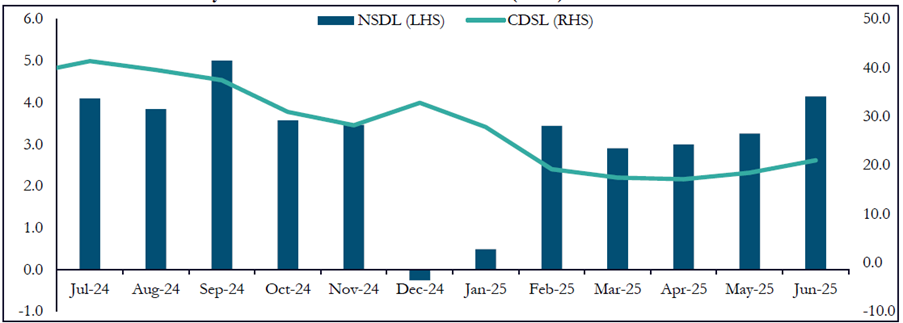
In the month of June 2025, NSDL and CDSL together added 25.1 lakh new demat accounts. At the end of month overall tally of demat accounts in India stood at 19.9 crore (NSDL = 4.0 crore; CDSL = 15.9 crore)
Monthly New Demat Accounts Added (lakh)
Source: SEBI Bulletin July 2025, citing NSDL and CDSL sources
Rising mutual fund investments
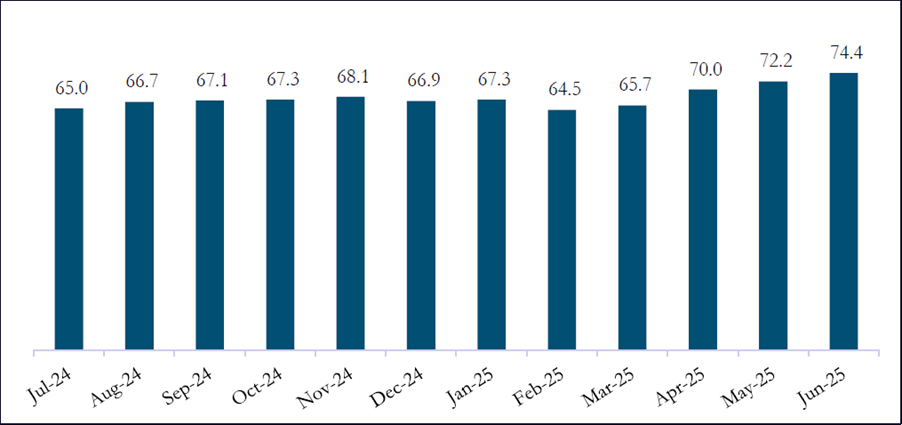
The investors continue to put in their money in mutual funds. This is reflected in net inflow of ₹49,954 crore in the month of June, 2025. The gross funds mobilized in the month was ₹13,96,855 crore against redemption/repurchase of ₹13,46,901 crore. At the end of the month the total investments stand at about 75 lakh crores. See the chart on assets under management of Mutual Funds below:
Assets Under Management of Mutual Funds (₹lakh crore)
Source: SEBI Bulletin July 2025
From the chart above it is seen that the interest of MF investors waned off when markets were falling. In the last one year, two months – December, 2024 and February, 2025 – witnessed more MF investors exiting the MF investments than those making fresh purchases. While some may see it as a response to reduce their risks in falling markets, it may also be seen as losing the opportunity to invest at lower costs. These are difficult choices to be make, as future is unknown. In fact, between September, 2024 and March, 2025 there were net withdrawals when markets were falling. Interest remerged post March, 2025 with rising markets.
Foreign Portfolio Investors
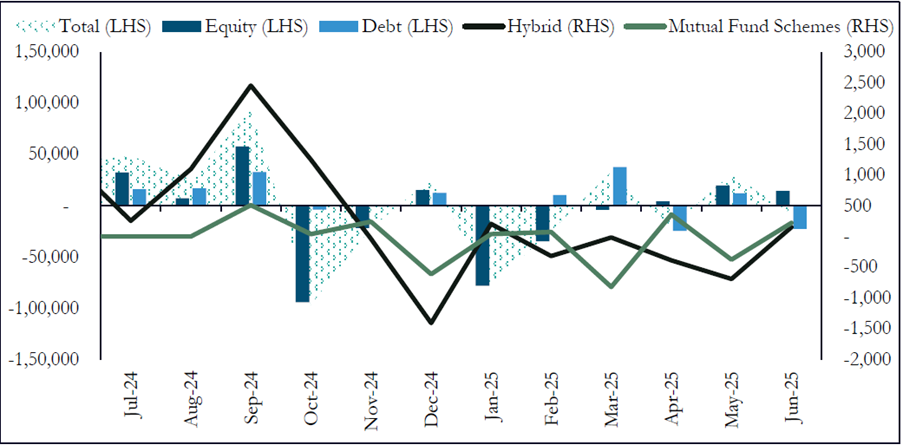
Investment trends of Foreign Portfolio Investors (FPIs) influence market sentiments and overall liquidity. FPIs tend to invest heavily in stable economies with growth potential and may pull out funds during the uncertain times. They move their funds between different markets based on their assessment of markets. While in June 2025, FPIs were net cash sellers of Indian securities with net inflows of ₹14,590 crore in the equity segment. In spite of this June movement, the trend is muted as FPIs have generally refrained from equity markets.
Trends in FPIs’ Investments (₹crore)
Source: SEBI Bulletin July 2025, citing NSDL sources
Are Equity Markets Overpriced?
As indices are approaching near their all-time highs, concerns about equity valuations are again surfacing, While strong domestic inflows have supported market momentum, the relatively muted interest from Foreign Portfolio Investors (FPIs) suggests caution.
One indicator drawing attention is the trailing Price-to-Earnings (P/E) ratio, which remains moderately elevated with Nifty P/E ratio stands at around 23.0. However, lack of strong FPI flows and rising global uncertainties make it essential for investors to be mindful. Markets are on a high again, and elevated P/E point towards overvaluation, even a slight bad news can mess things up.
Endnote
Lack of FPI interest and moderately elevated P/E warrant a cautious approach. In equity investing, patience and long-term perspective always wins. Do not chase the crowd to buy when valuations are high or exit when in panic in falling markets. Gradually build portfolios with long term horizons. In short:
1. Do not get carried away by the hype: Markets do not rise forever. When everybody is excited, it is a warning sign.
2. Have patience, buy more at dips: The best time to invest more is not when the markets are rising. It is when they are falling, and investors are scared to buy.
3. Be consistent: Do not exit markets as a knee jerk response to falling values of portfolio.
4. Have a long-term perspective: Retail investors in short term should not get too happy or get too panicked.
To get good returns it is better to have a long-term plan to invest in mutual funds or good quality shares. The plan may consist of simple systematic investments that are complemented with more purchases in case of falling markets.
Stick to your plan, stay alert, and let patience do the heavy lifting.