
Wealth has always been a subject of deep thought and discipline in Indian culture. Ancient Indian texts see wealth as a resource that is to be managed wisely for a balanced life. The money is to be divided between spending, saving and managed responsibly for values and growth. This article while taking cues from the ancient principles explains 50/30/20 modern rule of money management.
Wealth management in Indian mythology
According to Sukracharya’s Niti Shastra, wealth should be divided into five parts. One portion is for dharma, meaning charity and righteousness. Another portion is for sreyas, or self-development and future well-being. A third portion must be used to augment wealth through investments and savings. The fourth part should cover daily living expenses. The fifth part should go towards supporting relatives and social obligations. There are other ancient texts that explain how wealth should be handled. Chanakya’s Arthashastra emphasized the importance of state finances, taxation, trade, and savings, insisting that the root of wealth lies in activity and disciplined management. Manusmriti recommended that income be divided into four parts—dharma, enjoyment, savings, and family needs. These texts show that money must serve both practical and higher purposes.
50/30/20 Rule
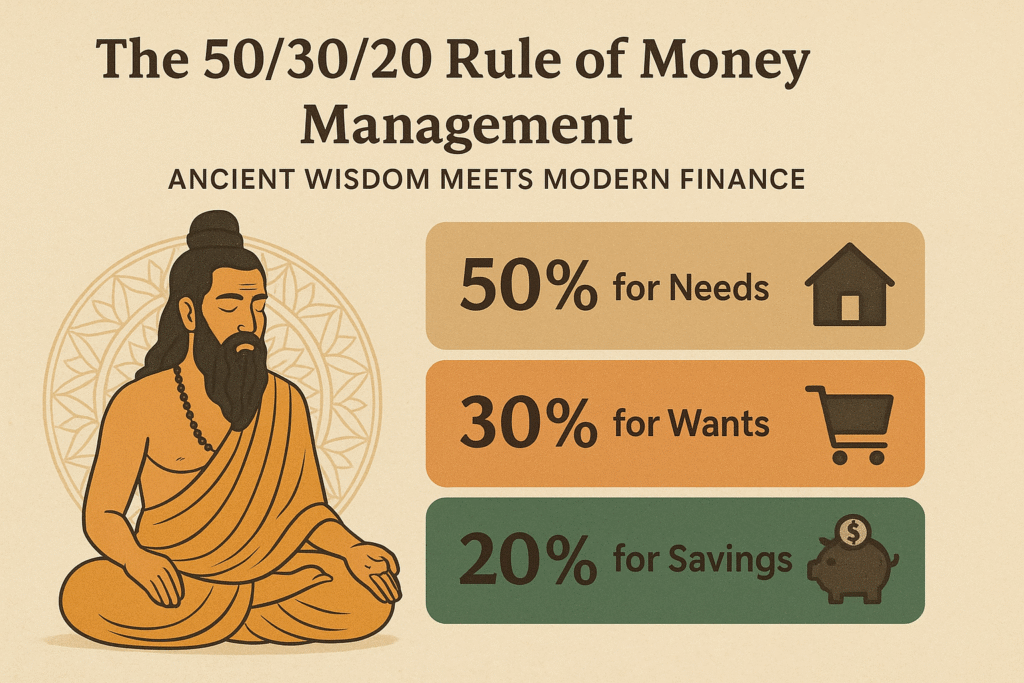
The 50/30/20 rule is a simple money management strategy that helps individuals to allocate their incomes. Attributed to U.S. Senator Elizabeth Warren the theme is to allocate money income so as to divide it as 50% on must-have, 30% on wants and 20% on savings. While Dharma of traditional Indian wisdom is missing, the rule can always be tweaked to include the same. In many rich or humble families, charity is a norm. Even otherwise, if you are rightly paying taxes, you are making some social contributions.
50% for Needs: Needs are basic and critical for living life. Half of the income should go towards essential expenses. These include rent, utilities, groceries, insurance, transportation, and like. The key idea is to ensure that basic survival and financial commitments do not exceed half your income.
30% for wants: The next 30 percent is allocated towards wants beyond needs. This category covers expenditure done to enjoy life by including wants that are not strictly necessary but are required for overall satisfaction. Examples include movies, dining, vacations, or Netflix subscriptions. These spendings are also important as life is not just meeting needs for survival. However, moderation is golden.
20% for Savings: The final 20 percent should be directed toward savings. This is where wealth creation truly begins. This portion covers building an emergency fund, retirement savings through provident fund, NPS, mutual funds, or SIPs, as well as investments in stocks, bonds, gold, or real estate. It may also cover paying down asset building loans such as a housing loan. By consistently saving and investing 20 percent of the income, the wealth grows.
The merits of 50/30/20 rule
The 50/30/20 rule is simple to understand and has several advantages. It is easy to remember and apply in our lives. The money is not just spent on essentials but judiciously allocated for wants and future security. The rule is flexible and can be adapted to different lifestyles and levels of income. The rule promotes financial discipline with consistent savings directed towards present and future financial health and security.
Final thoughts
The essence of money management are discipline, balance, and responsibility. The frameworks are guiding principles, but are not rigid formulas. Every individual’s is unique with different income, responsibilities, aspirations, and lifestyles. Therefore, while the 50/30/20 rule is an excellent starting point, wealth strategies are to be finalised suiting lifestyle and goals. Wealth creation is not about rules, it is about designing a plan that helps to live well today with a secure tomorrow.