
As Aarav walked into the dining nook attached to kitchen, his mind buzzed with the tax lessons from his father. He wondered how capital gains harvesting can actually take place. His mother, Sunita, stood by the induction, deftly flipping besan chilla. Standing just under five feet, she was a quiet a powerhouse, holding a master’s degree in mathematics and possessing an intellect to mentor any complex topic that Aarav found difficult in school or college. Yet, when in the matters of finance and investments, she always takes backseat.
Aarav walked up behind her, leaned down, and kissed the top of her head. “Morning, kiddo,” he teased. Treating her like the designated child of the house was a dynamics that both of them enjoyed. Sunita rolled her eyes with a smile, pointing her spatula toward the dining table. “Go sit. Your father is on juice duty.”
Across the counter, Rajesh was busy putting a fresh batch of oranges in the Juicer. Aarav watched the whirring machine and chuckled. “Mom, you literally have a higher IQ than both of us combined. How do you just let Pops to manage all the investments? Honestly, subverting the patriarchy starts at home, and you’re just letting him run the financial show!”
Sunita laughed, pouring the fluffy Chilla with Pudina Chutney onto his plate. “Aarav, true management is knowing how and when to delegate. And, why should I poke my nose on something he enjoys. Why spoil his fun?”
Rajesh walked over, placing a tall glass of juice next to Aarav’s plate he winked and added, “all investments are in her demat account. Letting me manage and then act like a boss who takes credit of all work done by subordinates.”
Rajesh continued “Finish your breakfast. Then we will talk about how to legally save on long-term capital gains using a strategy called Capital Gain Harvesting in Equity Investing.”
After the breakfast, the family sat across sofa set. Rajesh continued “long-term capital gains (LTCG) on listed equity shares are taxed at 12.5%. However, the tax laws provide a beautiful, built-in benefit: an annual exemption limit of Rs. 1.25 Lakhs”.
How Capital Gain Harvesting Works
He added “at your age, you need to build wealth over long term. You can have legally valid strategy where you intentionally sell a portion of your stock portfolio to realize gains up to the tax-free limit, and then reinvest the proceeds to reset your cost base.”
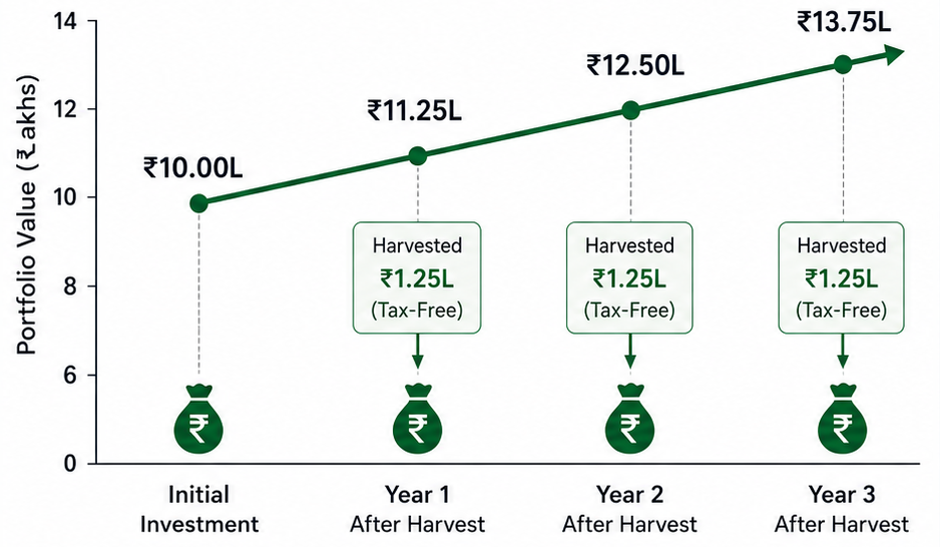
Rajesh tapped his iPad, waking up the screen to show a clean chart. “Look at this chart , Aarav. This is how you make the tax laws work for you instead of against you.” Rajesh used an example where an investment of Rs 10 Lakhs rises exactly by 1.25 lakhs for three years. In three years you will reset cost of acquisition to increase it by 3.75 lakhs.”
“After three years, you would reset the cost of acquisition from 10 lakhs to 13.75 lakhs. Suppose you hold these stocks for five years and sell everything at once for 15 lakhs. With your cost of acquisition as 13.75 L instead of 10 lakhs and the exemption available, you can walk off without paying any taxes.
Step-by-Step Execution: The Buy-Sell-Reinvest Loop
“So, do I just sell as soon as I complete one year? Aarav raised a question” Father frowned “No, the goal is not to exit the share. Reinvest to retain quality shares. The goal is to raise your Cost of Acquisition.”
Here is the exact procedural loop Rajesh sketched out on his iPad:
1.Verify the 12-Month Holding Period.
2.Check portfolio and identify stocks with potential capital Gains.
3. Sell identified stocks.
4. Reinvest the Proceeds in the same stock. You may also shift to other good quality stocks.
The Fine print to Keep in Mind
Sunita set down a cup of black coffee next to Rajesh. “Don’t forget to tell him about the leakages, Rajesh. Math doesn’t lie—friction costs eat into profits.”
“here is a true mathmagician,” Rajesh smiled. “She’s right, Aarav. While you save 12.5% on taxes, you must account for transactional expenses and consider other key aspects:”
- Brokerage and DP charges reduce the net tax benefit.
- STT paid on sale cannot be deducted from capital gains.
- Ensure the shares qualify as long-term capital assets before harvesting gains.
- Market prices may change between sale and repurchase.
- Evaluate the overall cost-benefit before executing the strategy.
- Tax laws may change and should be reviewed periodically.
- Tax considerations should complement, not drive, investment decisions.
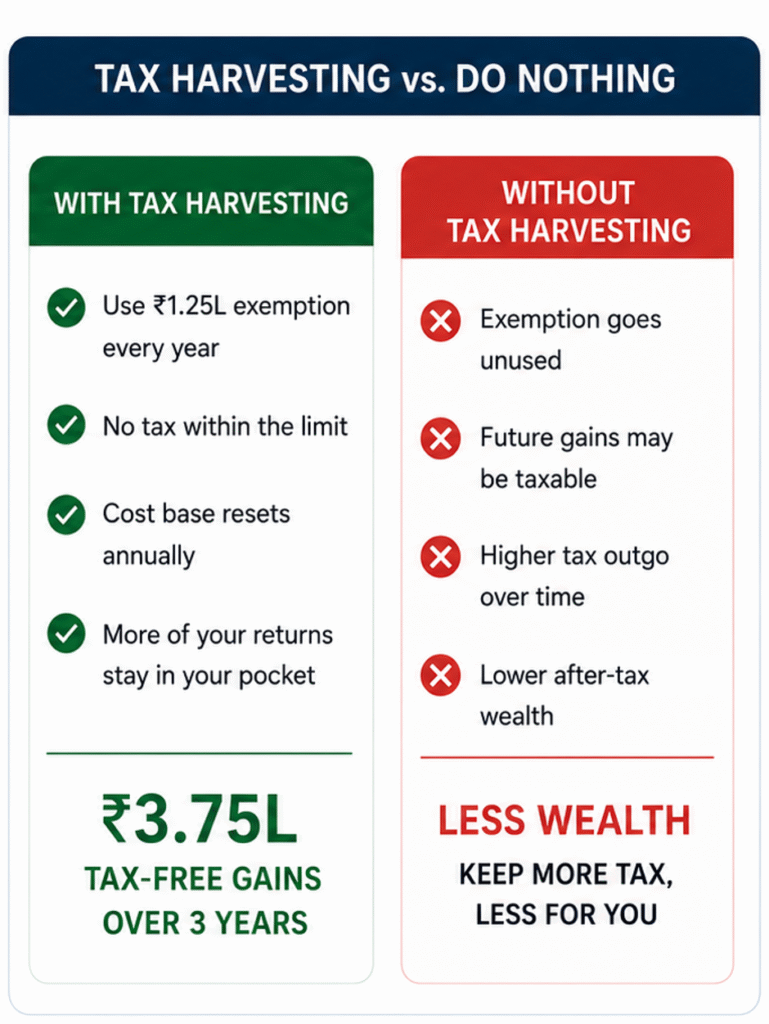
“Before we close”, Rajesh added, “harvest gains prudently as quick buy-sell transactions may be viewed as trading activity that involves different tax approach.
“Oh God! Aarav sighed. “Let us not enter into another area tax on trading activity today. I gotcha that by selling and reinvesting stocks kept for more than 12 months, I am essentially chipping away my future tax bill.”
“Exactly,” Rajesh said, locking his iPad. “It is legally compliant, highly efficient, and the hallmark of a smart investor. Just keep track of your transactions and do your math before the financial year ends on March 31st, and you’ll save lakhs in capital gains over your investing lifetime.”
In equity investing, tax harvesting is not optional housekeeping, it is a perishable benefit that disappears if not used within the financial year.
Also read,
Tax on long-term capital gains in certain cases. (Click here)